Fiction > The Children of Tellus > The Terrestrial Worlds
The Terrestrial Worlds
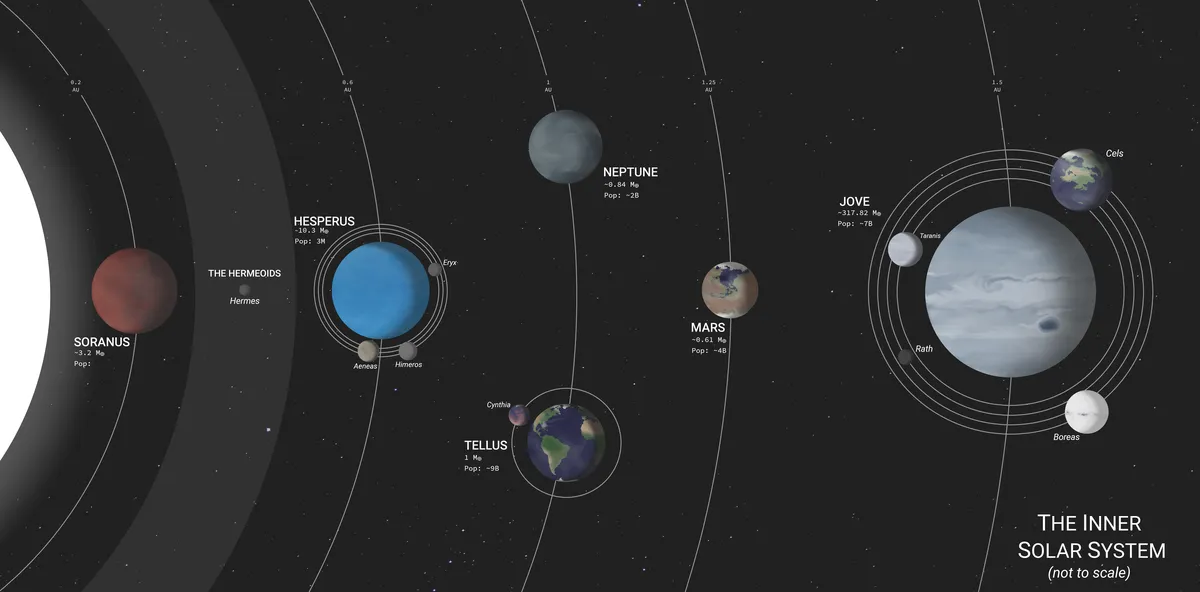 The Inner Solar System | View in Full Size!
§ 1 Phosphorus
Occasionally called Neptune, Phosphorus is a wet and temperate world. Uniquely, she orbits orbiting sixty degrees behind Tellus. Her surface is obscured by clouds -- it rains three days of five on the planet of love!
She is more oceanic than Tellus; while Phosphorus has thick granitic plates, they are covered with shallow seas. Her thinner basaltic plates are aquatic abysses, home to the same sorts of animals that dwell in deep trenches on Earth. Her only landmasses would be great mountain ranges on a drier world, and these are few and far between. However, most Phosphori do not live on land! There are great floating islands--masses of plants miles wide--as well as huge marine forests, jutting out of the water like mangrove trees.
As a result, the Phosphori have little metallurgy. However, this doesn't mean they don't have technology. They have bred hundreds of plant species for their own purposes--woods as strong as steel, predatory plants to act as sentries, even floating plants to serve as airships. This has been made easier because the Phosphori have long lifespans.
§ 2 Tellus
Tellus, or the Earth, is a warm waterworld. She is mostly covered by salty oceans, but there are seven large continents
Cynthia
Cynthia is Tellus' sole large moon (and, as a fraction of her orbital parent, the most massive moon in the solar system!). About 0.1 times as massive as Tellus, Cynthia is a living world with a thick atmosphere and rich biosphere. Her surface is split between shallow, fresh seas (called Maria) and dry land, often covered in purplish vegetation.
She is tidally locked to Tellus, making her day last as long as a Tellurian month. As a result, many animals hibernate or have very unusual sleep cycles. Cynthian humans have naturally split brains, one hemisphere sleeps for several hours while the other controls the body. Both typically share memories, personalities, and preferences, but occasionally something goes wrong and they function as two separate people.
Cynthians were in the gunpowder age during the twentieth century, but they abruptly entered the interplanetary age after many Martians immigrated.
§ 3 Mars
Mars is the smallest of the three habitable planets, just under two thirds as massive as Tellus. Most of his surface is covered in cold deserts, dyed red by iron oxide.
But, there are four shallow seas, and more lakes, each sheltering steppes and woodlands around their coasts. As a result, plants and animals are more isolated on Mars than the other planets.
Martian civilization is very old, only second to the Venusians. There were ancient ruins on Mars before Tellurians discovered agriculture. This is one of the reasons they were the first people to explore the Solar System: they had a big head start.
In the Early twentieth century, Mars suffered a series of great volcanic eruptions, leading millions of Martians to flee to other worlds. Some of them immigrated peacefully (as was the case on Cynthia and parts of Tellus), but others violently invaded and colonized other worlds (as happened in Eurasia).
Today, Martian civilization is a shadow of its former self. Mars has recovered from the crises of the early 20th century, but it does not have the same position of cultural and technological preeminence that it once did.
§ 4 Jove
Jove is a great gas giant, orbiting on the outer edge of the habitable zone. Unlike the gas planets of the outer solar system, his upper clouds are made of water - vapor, and they appear gray or bluish from a distance. He has four major moons, two of them fit for human habitation.
Taranis
Taranis is a large rocky moon, two thirds as massive as Tellus. His surface is completely covered with oceans. But, Jove's tidal forces heat him too hot for people: the seas are nearly boiling and the atmosphere is mostly made of steam.
But, his upper atmosphere is try and cool, and it has had a small but healthy population since the Martian exodus.
Some animals live beneath his seas, most of them around hydrothermal vents. A huge number of them have evolved onto crabs. Some of them are tasty, and they attract fishermen.
Cels
Cels is Jove's largest moon, just a tad more massive than Tellus is. Alone in the Jovian system, Cels is a temperate garden - world, the last in the solar system. Though Cels is colder than Tellus or Venus, she is far from frigid--tidal heating from Jove keeps her mild and cool.
Her interactions with Jove's magnetosphere creates beautiful aurorae, but there are also seasonal radiation storms which are dangerous to people and animals. This has led much Celish life to hibernate or live underground. The people of Cels are no exception; they prefer to live in caves, warrens, or vast subterranian fortresses. Over generations, they have grown slim, short, and big - eyed, and they tend to be shy and obsessive.
Rath
Rath is a small and airless moon, covered in craters and devoid of life. But, a number of cultures have come here to build mines and factories (most of them Martian or Celish).
Boreas
Boreas is a small, cold world, mostly covered with ice and slush. But there are some warmer and more temperate regions, mostly in the tropics. Geologists believe he was once a lush and warm planet, and he was densely inhabited in the past. But, recently, he has collapsed into an ice age, and civilization has retreated with it--there still are sedentary societies on Boreas, but they are far smaller than they were long ago.
The Boreads themselves are exceptional at quantitative reasoning. A bright Boread can perform most arithmetical calculations in seconds, and she has an intuitive understanding of trigonometry, probabilities, and exponents. This makes them more rational than other peoples in many respects, and they quickly advanced towards industrial technology. However, they went no further, because Boreads never had any reason to invent computers. In the twentieth century, all of Boreas was conquered by the Martians, who had drones and advanced AI systems. Today, parts of it have been thoroughly decolonized, though others have evolved into mixed cultures or apartheid states.
Next => | The Outer Solar System
The Central Solar System | <= Previous