Fiction > The Children of Tellus > The Central Solar System
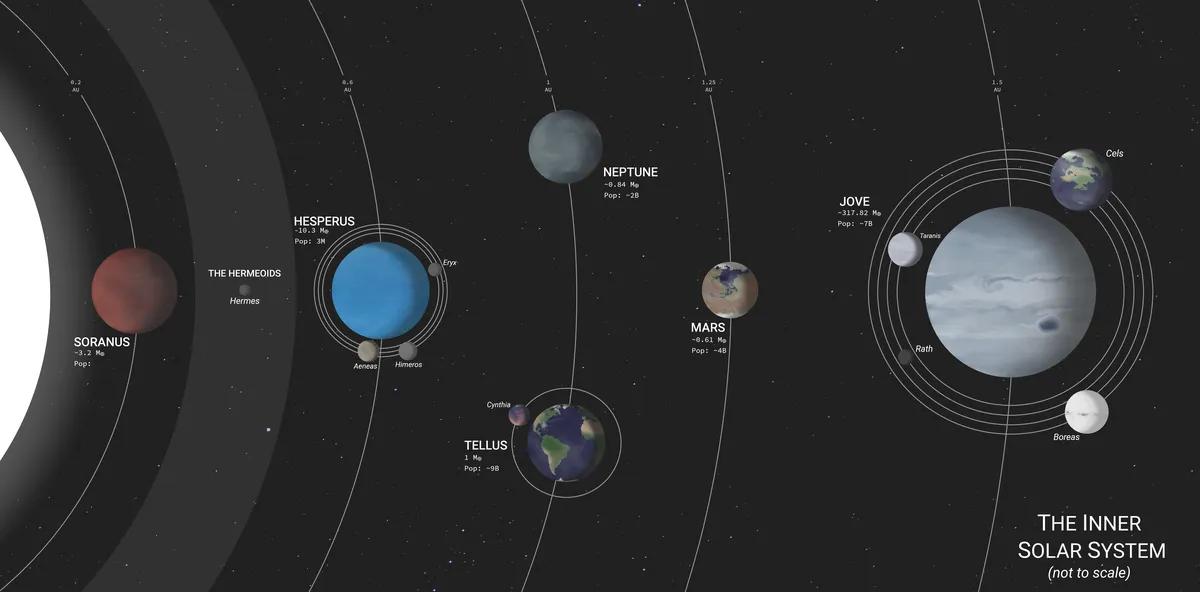 The Inner Solar System | View in Full Size!
The Central Solar System
The Central Solar System is the first and hottest region of space, extending from the Sun to the orbit of Hesperus. A few moons may support microbes, but there are no native plants or animals (and certainly no people).
Nonetheless, it has been inhabited since the late 19th century. First there were drones, then scientists. Then, there was a small but steady stream of settlers. Some of them were practical people, asteroid miners seeking their fortunes. But, they were followed by a steady stream of eccentrics--Haredim, radical libertarians, lesbian separatists. Today, it is the most diverse and unstable region of space. There are literally hundreds of polities, and only some of them are beholden to the great powers of the Seven Earths.
§ 1 Soranus
Soranus is the first and hottest planet, a tidally - locked super - Earth. Its dayside is covered by seas of lava, but the nightside is relatively cooler, only home to sporadic molten patches.
Soranus endures the brunt of the solar wind, which would make most worlds bare and airless. But, being large and geologically active, he is able to maintain a thick atmosphere (and is extremely windy!). A few people live on or around Soranus, but few stay there. At any given time, most of his inhabitants are field geologists, and most of them will eventually return to cooler and wetter worlds.
§ 2 The Hermeoids
The Hermeoids--or the Inner Asteroid Belt--is a torus - shaped region of space, stretching from 0.3 - 0.6 AU. It is home to multitudes of asteroids, most of them highly metallic. Many scientists believe they're the remains of an ancient rocky planet, the core of which might be Hermes.
Tens of thousands of people live in the Hermeoids, usually in space - stations dug into asteroids, each a little city - state. There are hundreds of these colonies. Some are reclusive, others are open. A few are warlike and expansionist, but too much tomfoolery usually earns the ire of some terrestrial power.
Hermes
Hermes is a tiny dwarf planet, heavily cratered and desolate. It is heavily metallic and abundant in useful minerals, and this has attracted miners from across the solar system. There are many large colonies on Hermes, most of them owned by some terrestrial government.
§ 3 Hesperus
Hesperus is the dawnstar and the evenstar, the brightest object in the night sky. Uniquely in the solar system, Hesperus is a mini - Neptune; he does have a large rocky core, but it is obscured by miles upon miles of gases and volatiles. His outer layers are deep blue, making him associated with sapphires in many cultures.
Bathed in the solar wind, Hesperus' atmosphere is being gradually stripped away, it is estimated that it was much more massive in previous ages. Eventually, millions of years hence, Hesperus' atmosphere will be totally carried away, leaving a rocky, airless core.
Hesperus has three small, barren moons, all rich in useful minerals. They have all been mined and colonized as a result, and today the are home to thousands of people.
Eryx
Eryx is the nearest moon to Hesperus, and consequently is subjected to great tidal forces. This makes him quite geologically active, scarring his surface with earthquakes and volcanism. As a result, he appears less cratered than Hesperus' other moons.
Aeneas
Aeneas is Hesperus' largest moon, ~6% as massive as Tellus. In ancient times, it appears to have been a green ocean world. But the sun grew brighter and hotter, and his seas turned to steam. Soon they were blown away by the solar wind, leaving miles upon miles salt flats.
There is still some liquid water on Aeneas, almost all of it in aquifers (though there are a few ponds in polar depressions).
Due to its higher mass and slight atmosphere, it's more expensive to travel to Aeneas than to Himeros of Eryx. As a result, fewer people live there, and the people who do tend to be very odd.
Himeros
Himeros is a little rocky world, heavily - cratered and crisscrossed by rupes. It's 0.055 times as massive as Tellus, and quite dense. About 70% of his mass is accounted for by metals. Millions of people live and work on Himeros. His high metallicity makes him an ideal location for mining, and his low gravity and nonexistent atmosphere makes it easy to export minerals.
It's an extremely cosmopolitan place; the Himeri come from all creeds, cultures, and planets. But, they have developed their own cultural identity, and have lately united behind a single Himeri state.
Next => | The Terrestrial Worlds
The Solar System | <= Previous